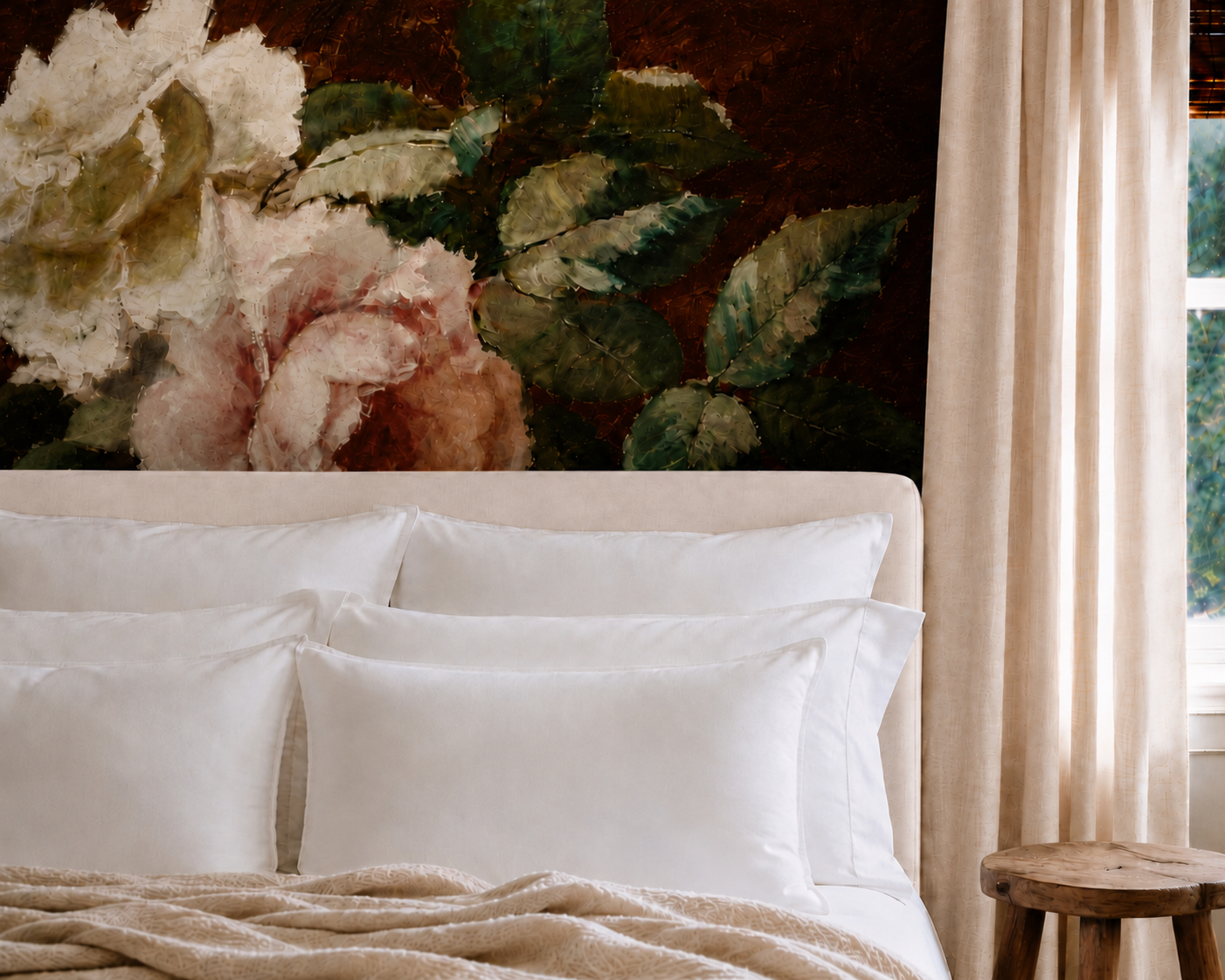
Your bedroom is the most important room in your home. It holds your rest, your health, and the quality of your most intimate relationships. How it looks surely matters, but what matters more is what it does to you while you sleep. Most bedrooms contain at least one thing that is working against the person sleeping there. Here is a simple guide to what supports rest and what doesn’t, from the colors of bedroom walls to the big plant by your bed.
Colors
The most restful bedroom colors are skin tones, from soft white and light sand to warm caramel and deep chocolate brown. These colors create a quality of warmth and grounding that your body responds to, especially at night. Think of them as the visual equivalent of a warm embrace. Add touches of warmth through accent colors: soft red, pink, coral, lavender. These bring sensuality and life to the room without overwhelming it. Avoid the presence of green as a dominant wall color. Green carries the energy of growth and upward movement, which is excellent in a living room, study or kitchen, but too activating for a bedroom. Small touches are fine. A green wall is not.
Mirrors
Mirrors are powerful. In the right place, they bring light, space, and beauty. In the wrong place, they create restlessness. The one placement to avoid without exception: a mirror facing your bed. This creates a subtle but persistent disturbance that affects both your sleep and, if you share the bed, the quality of the relationship. If you have a beautiful tall mirror in your bedroom, move it so it does not directly reflect the bed. If you love it and cannot move it, find a way to cover it at night or move it to another room.

Plants
Plants are wonderful in almost every part of your home. The bedroom is the one exception where restraint matters. At night, plants release carbon dioxide. In a small bedroom with a large plant close to the bed, this affects the quality of air you breathe while you sleep. A small plant on a windowsill or a fresh bouquet on a dresser across the room is fine. A large grouping of tall plants near the bed is not. The general guideline: the smaller the bedroom, the fewer the plants. If your bedroom is spacious and the plants are far from the bed, this can work.
What to remove
Some things simply do not belong in a bedroom. These are not preferences but rather clear guidelines based on what disrupts a space designed for rest.
- Television. A TV in the bedroom takes over the room’s energy. Whatever it emits: light, sound, electromagnetic activity, replaces the nourishing, quiet quality your body needs to restore itself. You either want a bedroom that supports your health and intimacy, or you want a TV. You cannot have both.
- Computer and phone. Keep your phone away from the bed. From the bedroom in general is even better. No laptop in the bedroom, either. While convenient to have, they generate high electromagnetic fields that have measurable negative effects on your health.
- Office desk and work materials. No matter how well designed your workspace is, the energy of work and the energy of rest just do not coexist. Having work related items in your bedroom introduces a subtle (or not so subtle) restlessness that drains both your sleep and your productivity.
- Exercise equipment. Same principle. Active, driven energy does not belong in a room intended for rest, relaxation and sleep.
- Clutter under the bed and in the closets. What is stored out of sight still affects the room. A cluttered closet and boxes under the bed create stagnant energy that you sleep in every night. Clear them.
What to keep
Fresh air. Open the windows, even briefly, every day. Natural light during the daytime. Comfortable natural bedding. Candles or dimmer switches to soften the light in the evening. Art that makes you feel calm, safe, happy, loved. Your bedroom is an outward expression of how you care for yourself. The more honestly you tend to it, the more it gives back.

Rodika Tchi works with private clients worldwide to create homes that support health, relationships and daily life. She is the author of two published books and has been interviewed by Psychology Today, Business Insider and Elle Décor.
Share


