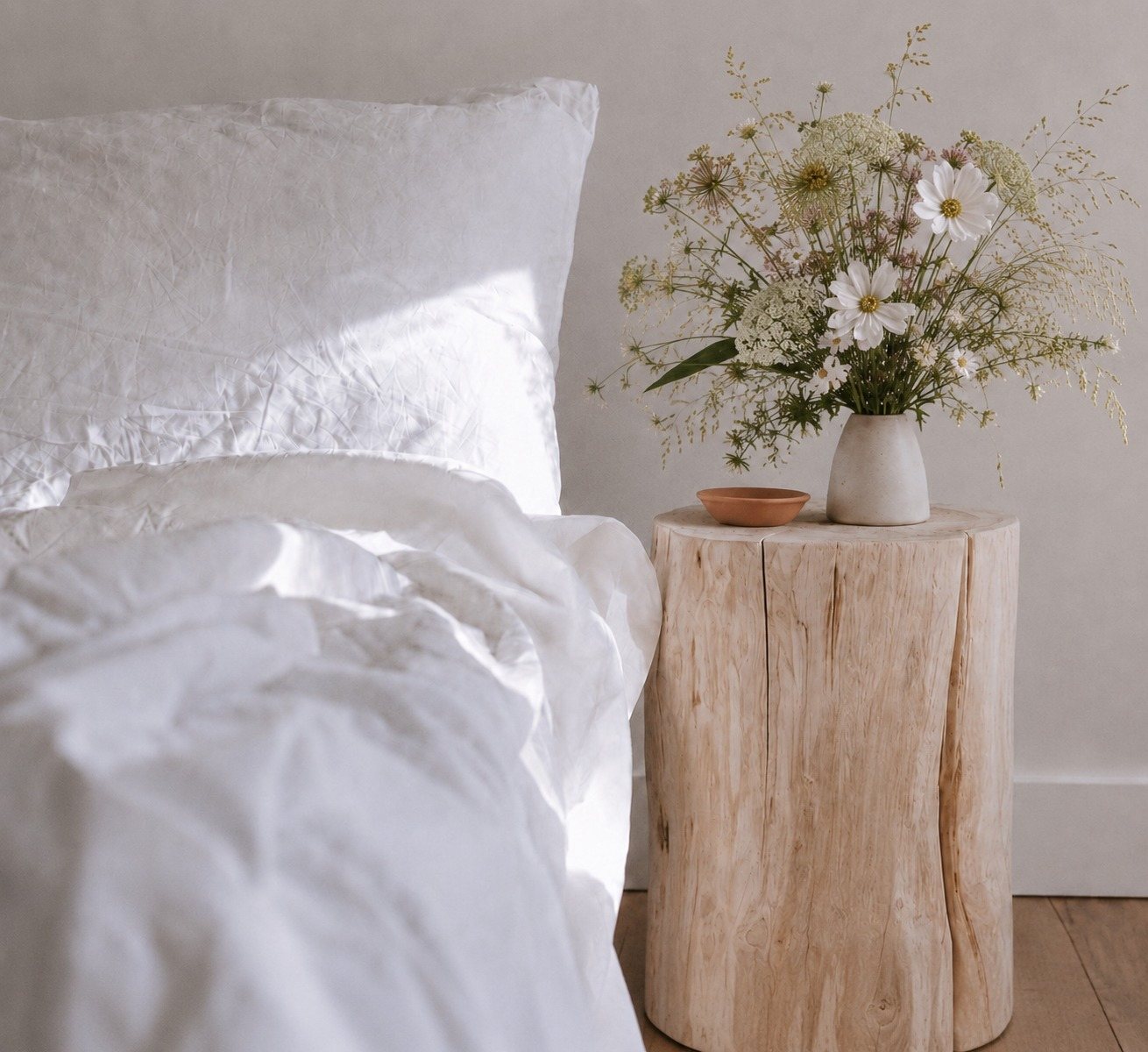
Your bed is the most important piece of furniture in your home, as it is directly connected to your health. Where you place it, and its relation to the door, the windows, and the walls determines how well your bedroom supports your rest, your relationships and your sense of safety. The layouts I am sharing with you are not rigid rules, but strong recommendations based on energy flow patterns studied for centuries. Some bed positions will leave you exposed and feeling unsettled. Others will make you feel protected and safe. The wisest way to go is to allow yourself to experiment and, if you have several choices for your bed placement, actually feel in your body how it feels in each. Which spot is more restful? Which one feels too active? Every bedroom is different, but here are three layouts that consistently create best conditions for deep, restorative rest.
Layout #1

The strongest bedroom layout places the bed diagonally from the door, with a solid wall behind it. You can see the door from the bed without being directly in line with it. A good headboard and balanced nightstands on both sides (they don’t need to match) ground the bed and give it stability.
A rug beneath the bed grounds the energy even further. If you have a larger piece of furniture like a chest of drawers or armoire, place it at the foot of the bed rather than beside it. This keeps the room balanced. Not every bedroom allows this exact arrangement. The one variation that still works well is placing the large piece of furniture on either side of the bed, balanced by a similar piece on the opposite side. The bed doesn’t need to be centered on the wall; that depends on where the windows are. What matters is that it is placed diagonally from the door, has a solid wall behind it, and space on both sides.
Layout #2


This layout works when the door is to the side rather than directly across from the bed. The bed is still away from the door, still backed by a solid wall, and still grounded on both sides. Notice how the largest piece of furniture slows down the direct path of energy between the door and the window. When the bedroom door and the window face each other, energy moves through the room very quickly, which can leave you feeling unsettled. A piece of furniture placed between them creates a sort of buffer. Think of it as a triangle between the armoire and the nightstands; this gives any bedroom its most balanced layout.
Layout #3

The third layout places the bed on the same wall as the door, or a nearby wall. The bed is still protected and grounded. If this is your only option, leave as much space as possible between the door and the bed, while still allowing room for a small nightstand on the far side.
The best layout for your bedroom depends on the specific placement of your doors and windows. These three options give you a good starting point, but if none of them works perfectly in your room, be sure the principles still apply: keep the bed away from the direct line with the door, have a solid wall behind your bed, and ground it on both sides.
Your bedroom layout determines how the energy sets and its ability to support you, but what you keep in the bedroom is equally important.

Rodika Tchi works with private clients worldwide to create homes that support health, relationships and daily life. She is the author of two published books and has been interviewed by Psychology Today, Business Insider and Elle Décor.
Share


