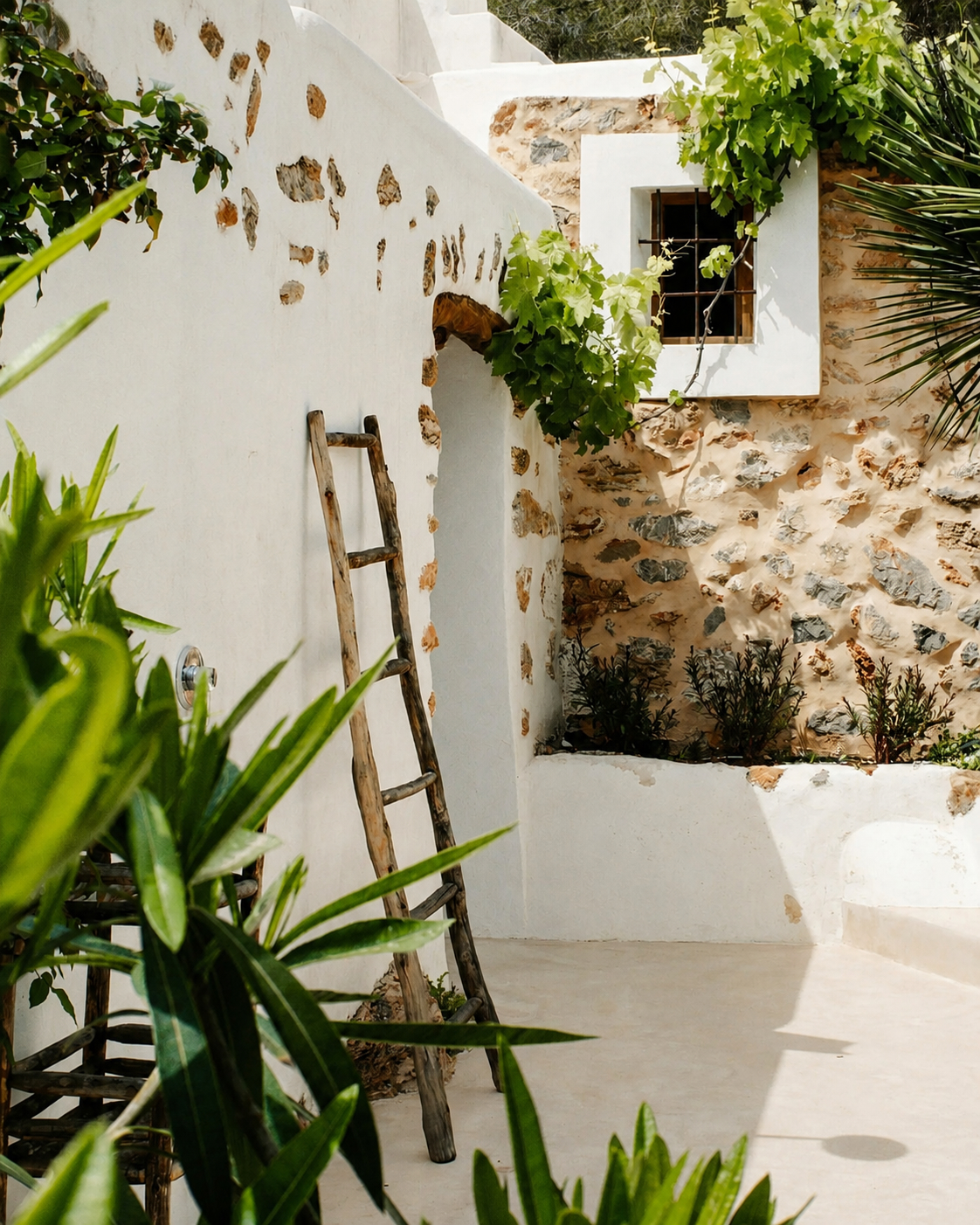
Walls with soft edges, never sharp. Mismatched chairs that somehow belong together. Art hung sweetly, not in line. Colors that are both soft and intensely saturated: white from lime, yellow from the sun, blue from the sea and sky. Handmade things passed down from wise grandmothers who never questioned their taste. Everything is at ease, even when it looks at odds.
There is no need to perform in these rooms; in their simplicity, they see you so clearly that any trying feels ridiculous. So you drop it, and you exhale. It’s a foreign land but somehow it holds you closer than the home you left behind.
What is in these places that make you feel so safe?
What do they know that we have forgotten?
This knowing doesn’t come in clear words, but rather in slowly unfolding deeper feelings. One has to sit with them, and let them be, and then they might (or might not) give access to memories of how these houses came to be. Built slowly, by people who did not feel themselves separate from their land, people who knew how to listen. That listening is what made everything belonged.
Nothing fought the landscape or competed for attention. The thick walls felt protective and snug, while keeping the heat out and the coolness in. The small windows framed the light instead of flooding the room with it. Colors came from loving what was already there: ochre of the earth, blue of the sea, white of the limestone. Rooms were small because most life happened outdoors. The kitchen was the center because food was the center. These spaces were not designed to impress but to work well for those living there.
Somehow, somewhere, we reversed this. We started building homes for those who look from the outside rather than those who live inside. Materials chosen for how they look, not how they feel to touch. The intimate relationship between person and place was quickly traded for an impressive look. But looks alone cannot sustain, eventually they start depleting you.

The same happened with food. The Mediterranean diet has been studied to oblivion but what makes it work is not just the ingredients. It’s the way people enjoy sitting together, the slow pace of cooking, the simple kitchen by the garden. Extracting the diet from the table, the table from the room, and the room from the land is a silly attempt to separate what can’t be separated.
The Mediterranean houses, too, cannot be separated from the land they stand on. This sincere relationship with everything, from food to walls, rooms and time itself, rests on something very old and solid. It’s in all these houses, making them feel settled, undemonstrative, never doubting what truly matters.
Calm and quietly sure of themselves.
Their soothing this too shall pass energy is very healing. I spent quite a bit of time in Crete while going through big life changes. I did not really do much there. My only time-sensitive commitment was to catch the tiny grocery store in its random open hours; I needed to have enough milk in the fridge for the wandering army of kittens. Other than that it was just me, the cottage, and the sea with a few caves high above it. I found one that felt so comfortable and had the most amazing view, and I kept returning to it. And then I realized, wait, I feel as snug and comfortable in this cave as I do in my little cottage. I feel safe, taken care of and so welcome, even though I am definitely a total stranger here.
This connection between the land and the built spaces was so very healing for me. I will never forget that time, and how the little cottage and the cave high above the sea felt almost the same: caring, solid and powerful. They allowed me into their ancient relationship, and I was held there safely.
So I understood that what makes Mediterranean homes so special is not a design language but a sincere relationship. Unfolding slowly, requiring one thing only: to be present. No complexity, no trends, no colors of the year.
Image: Monique Nakeqr

Rodika Tchi works with private clients worldwide to create homes that support health, relationships and daily life. She is the author of two published books and has been interviewed by Psychology Today, Business Insider and Elle Décor.
Share


